Din aceeași categorie

Introduction
COVID-19 is a contagious infectious disease that affected a large number of people around the world. It manifested with forms ranging from asymptomatic to severe, including death(1).
Referring to the training of medical students and residents in all medical specialties, the COVID-19 pandemic has significantly affected their professional training(2). A study conducted in 2020 on the training of orthopedics and traumatology resident doctors during the pandemic showed that most of them were negatively affected in their professional training during this period, referring to surgical and clinical training. This study included 327 resident doctors from 23 countries in Europe, and 52.1% of them claimed that their professional training was negatively affected during the pandemic, while 58.6% of them mentioned that their surgical training was significantly affected. However, 25% of the participants said that they needed an additional year of residency training(3,4).
The COVID-19 pandemic also had negative effects on healthcare systems around the world: elective surgeries or non-emergencies were cancelled, the number of consultations and the number of patients who were medical emergencies was reduced in hospitals(5). All these factors dramatically affected the training of medical staff and the negative consequences were not only limited to the clinical and surgical training of medical staff, but also had negative effects on the physical and mental state of resident doctors(6,7).
In the pandemic period, a program called House Officers in Malaysia was realized and included medical school graduates who had to complete their training program in a shorter time – two years. Under this program, they were required to complete training modules in each specialty over a period of four months. The results of this two-year program showed that participants were exposed to a high level of stress during pandemic(8).
Another study was conducted in Italy on 933 obstetrics-gynecology resident doctors to show the impact of the pandemic on their medical training using an online questionnaire that included 45 items. Only 476 of those who received the questionnaire answered the questions and 54.7% responded that their training was negatively affected during the pandemic. A percentage of participants stated that they were anxious about their professional future and 59% of them mentioned that their professional training had been irreversibly compromised(9-11).
In correlation with data from the literature, we realized a study that evaluated the impact of the COVID-19 pandemic on obstetrics-gynecology resident doctors in Romania, also corelated with COVID or non-COVID status of the hospitals.
Materials and method
We performed a prospective study which included a questionnaire that was distributed online over a two-month period (25 September 2021 – 30 November 2021) and was addressed to obstetrics-gynecology resident doctors. We realized a questionnaire that included a number of 18 questions about age, gender, year and city of study, whether they worked in a COVID support unit, how they were affected by the pandemic period, the skills acquired during the pandemic period, as well as questions about their future plans. The responders were from all university centers in the country, most of them from Bucharest, then Cluj, Timişoara, Craiova, Braşov, Constanţa, Iaşi, Arad and Târgu-Mureş. All those who answered the questionnaire worked in Romania.
The inclusion criteria were represented by the medical specialty, because the questionnaire was designed for obstetrics-gynecology resident doctors. The exclusion criteria were represented by other medical fields. There were no exclusion criteria based on gender. The topics of discussion were related to their professional activity during the pandemic and how they were affected. We based this on their response to the question related to their work in COVID versus non-COVID support unit. Many questions were related to their professional activity during the pandemic period, how this was affected, how the surgical activity was affected, or the number of births performed during the pandemic period. There were also questions about the theoretical training and support from the residency coordinator during that period, whether they learned triage procedures for positive patients, how to manage pregnant COVID-19 patients with gynecological pathologies, and how they were affected physically and psychoemotionally during the pandemic period. The participants were also asked about their fear of infection with SARS-CoV-2 in hospital units and whether they planned to live or work in our country in the future. The data were collected and processed using online methods and the Excel program.
Results
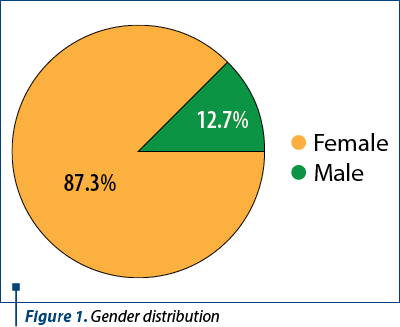
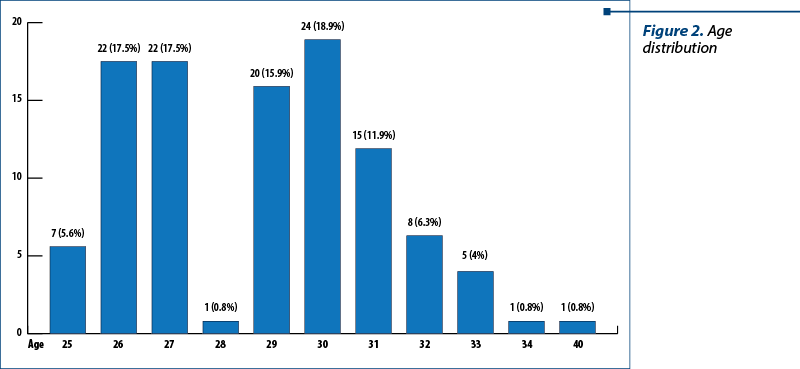
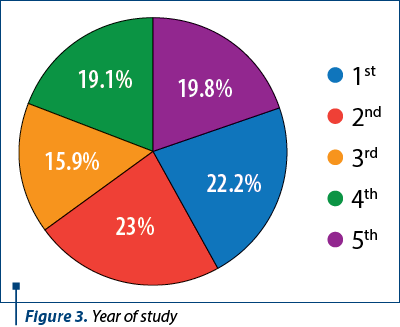
The study included 126 resident physicians in obstetrics and gynecology who accomplished the inclusion criteria. Most of the participants were female (87.3%; Figure 1), the mean age being 32.5 years old, with ranges from 25 to 40 years old (Figure 2). The group included a balanced percentage from the first year to the fifth year; 22.2% of them were in their first year of residency, and 19.8% in their terminal year (Figure 3). Resident doctors from all over the country answered, especially from Bucharest, followed by Craiova, Timişoara and Braşov, and fewer participants from Cluj-Napoca, Iaşi, Constanţa, Arad and Târgu-Mureş.
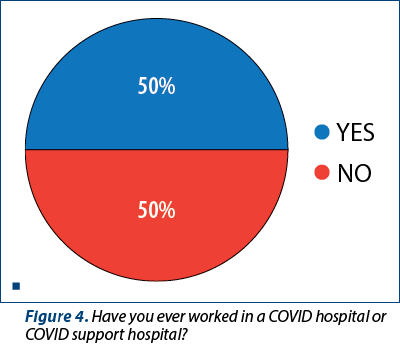
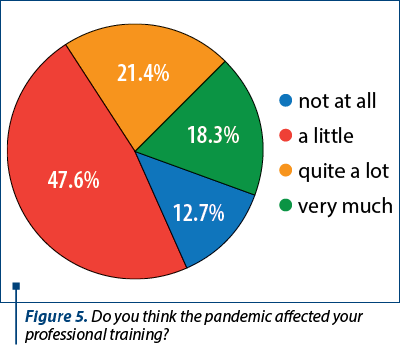
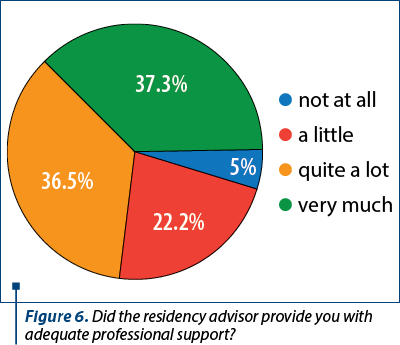
The ratio of obstetrics and gynecology residents who answered the questionnaire and worked in a COVID versus non-COVID unit during the pandemic was equal (Figure 4). A percentage of 18.3 of the participating said that the pandemic period severely affected their professional training, 21.4% of them moderately and 47.6% in a minor way. Only 12% stated that they were not affected during this period (Figure 5). Regarding the surgical activity, only 27% of the respondents did not consider that the surgical activity was affected. Regarding their support from their residency supervisor, 73.8% of those who participated in this study said they received much or a moderate support, while 22.2% said they received little support, and a few said they received no support at all from their residency supervisor (Figure 6).
The triage procedures implemented in all health facilities during the pandemic period were understood by most respondents: 29.4% had learned a lot of triage procedures, 41.3% quite a lot, 24.6% of participants said they learned a little, and only a few said they had not learned triage procedures for COVID-19 positive patients at all. Triage procedures refer to the measurement of blood pressure, pulse, temperature, peripheral blood oxygen saturation, questions such as traveling to another country with high pandemic risk, contact with a person suspected or diagnosed with COVID-19 or imposition of quarantine. Also, in some hospitals, residents were asked to do shifts at triage centers, as well as collect rapid antigen or PCR tests from patients who were to be consulted or admitted.
Regarding the management and medical activity provided strictly to COVID-19 positive patients – pregnant or with gynecological pathologies, this was learned by a significant proportion of respondents. Among these, those who worked in exclusively COVID hospitals (14%) or mixed (30%) were remarkable. On the other hand, the same 14% of residents in non-COVID hospitals did not have the opportunity to be trained in providing obstetrics and gynecology care to COVID-19 positive patients, which is a special care, especially at the beginning of the pandemic when information about pregnancy, organ damage, lung and respiratory damage, fetal distress or treatment and approach was controversial.
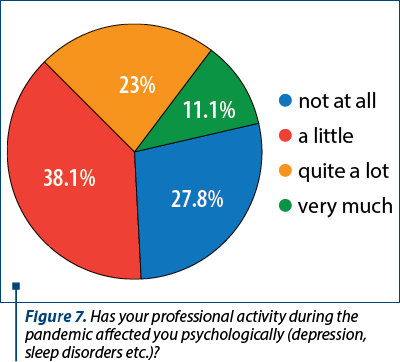
In terms of physical damage from the pandemic period (fatigue, burnout), 15.9% of the resident doctors who participated in this survey said they were affected very much, 34.9% said they were affected a lot, while 38.9% and 10.3% of the responded that they were a little physically affected or not affected at all during the pandemic. In terms of psychological impairment such as depression, sleep disorders or other problems, 11.1% and 23% affirmed that they were affected very much and a lot, while 38.1% affirmed that they were affected a little, and 27.8% of the resident doctors responded that they were not affected psychologically at all (Figure 7).
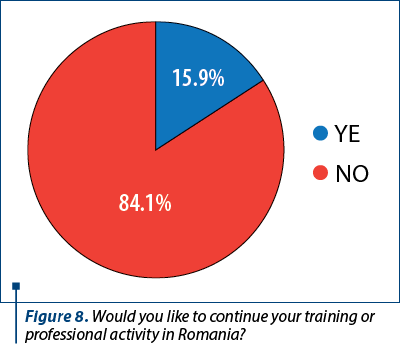
Regarding the pathology and its diversity that the resident physicians who responded to this questionnaire saw during the pandemic period, 7.9% said they saw a lot of diversity, 21.4% quite a lot, 50% a little, and 20.6% said they saw no diverse pathology at all during the pandemic period. 84.1% declared that they want to continue their training and professional activity in Romania in the future (Figure 8).
Discussion
The impact of the COVID-19 pandemic on the training of young doctors is a global concern and the period of pandemic was equivalent to about 30% of the residency training for obstetrics and gynecology(12). Most resident doctors who participated in this questionnaire were negatively affected in their surgical activity, obstetrics and the variety of pathology which they had access to. Resident doctors were impacted differently by this period, depending on the unit in which they were working, COVID versus non-COVID support hospital. The results are relevant because, out of the resident doctors who responded to this questionnaire and were included in the study, half came from COVID support units and half came from units where no positive patients were treated, so the errors are minimal.
The COVID-19 pandemic has disrupted hospital care, as units had to cope with a highly infectious virus while continuing to meet the health service needs of their communities, reported a recent study from September 2021 aimed at examining the direct effects of COVID-19 on hospital care delivery(13). The reduction in hospital inpatient activity during 2020 can be attributed to several factors, such as closure and quarantine, reorganization of hospital operations, rationalization of the medical workforce and people’s reluctance to seek hospital care(14-16). All of these had unfavorable consequences on the training of residents, such as the obstetrics and gynecology resident doctors who answered the questionnaire. The results were influenced both by the low number of COVID-19 positive patients requiring admission or consultation compared to the negative patients who came to the hospital, and by the fact that during the pandemic period all surgeries were postponed or cancelled, and the number of consultations per day was significantly reduced. As it can be seen from the responses of the participants to the questionnaire, most of them answered that the pandemic year affected their professional training, surgical activity or the number of assisted deliveries. We had no information regarding this aspect, but we suspected that the residents who responded that their professional activity was not affected at all during this period came from maternity hospitals that did not treat positive COVID-19 patients and their professional activity during this period was not negatively influenced. It should be mentioned that most of the participants in the questionnaire have learned to manage positive pregnant or gynecological patients.
A study conducted in July 2021 also reported that the COVID-19 pandemic had a huge negative impact on the mental health and general well-being of people around the world(17). Studies showed that these psychological challenges were very important for healthcare workers, particularly nurses. Indeed, several studies reported that nurses suffered more from the psychological consequences of the pandemic than doctors(18). Across studies, it was a strong evidence that nurses showed poorer mental health outcomes compared to physicians during the COVID-19 pandemic. This was particularly true for symptoms of depression, anxiety and post-traumatic stress disorder (PTSD). In this case, the prevalence rates among nurses were often higher than 50%(19). High levels of stress and burnout appeared to be comparable between nurses and doctors, and special programs are needed to help them(20,21). Referring strictly to the present study of the resident doctors who responded to the questionnaire distributed online, a very small percentage answered that they were not affected psychologically at all during the pandemic; another part of them said they were affected by symptoms such as depression and sleep disorders. Also, in terms of physical impairment, only one tenth of respondents answered that they were not physically affected by symptoms such as fatigue, overwork or burnout. This is a result we expected because we know the consequences of the pandemic on the whole world, both in and out of hospitals, and these results support the previous studies already published. Also, in this case, significant differences were evident between the training of resident physicians in COVID hospitals and those who have not consulted or admitted COVID-19 positive patients. This percentage makes us raise many questions about what we can do about it, what we could have done to prevent it, and how to prepare and avoid similar situations in the future.
Regarding the risk of contracting the virus at work, only 6.3% of the participants said they were afraid of this. Looking back a few years ago when the SARS-CoV-2 was an uncertainty, there were not enough studies, it was not known how to deal with the pathology given by this virus, how to treat patients, especially those with other associated pathologies and what would be the short-term and long-term consequences, we understand why they were afraid.
Most of the resident doctors who responded to the questionnaire said that they had learned to do triage procedures for COVID-19 positive patients, procedures such as measuring temperature, blood pressure, clinical evaluation for cough, difficulty breathing, myalgia, arthralgia, headache, nausea, vomiting etc. Only 4.7% of the participants stated that they had not learned the triage procedures at all; they come from hospital units where no confirmed SARS-CoV-2 patients were treated, too.
Regarding their support from their residency supervisor, 73.8% of those who participated in the survey said they received very much or a lot of support, while 22.2% said they received little support, and a few said they received no support at all from their residency supervisor. This is encouraging because both outside the pandemic and especially during the pandemic, and moreover in COVID support hospitals, where all professional activity of the entire medical staff has been negatively affected, residents need the support of the mentor.
The departure of medical staff from our country is a reality known for over a decade in Romania, and the pandemic has exacerbated this trend. The questionnaire reveals that this trend was not valid for our specialty – 84% of respondents wanted to continue their training or professional activity in Romania. This result is very pleasing to us. We need young, well-trained doctors; it is a well-known problem in our country’s hospitals, namely insufficient medical staff, both doctors and nurses.
In this questionnaire distributed online to the residents, they had the opportunity to answer freely to the last question about the training process in the medical specialty in that period. Some of the answers were: “The Ministry should redistribute to other hospitals the residents from the COVID support hospitals (...) It is not right that some units function normally and others not; the residency lasts the same number of years and they all take the same exam” or “the possibility to manage chronic cases further”, “I would like a rotation; there would be a smaller number of doctors in the health unit at the same time”, “It would be beneficial to organize hands-on courses, ultrasound, laparoscopy, surgical techniques” or “The existence of a booklet containing the mandatory minimum number of obstetric and surgical maneuvers we must perform by the end of our residency”.
Conclusions
The division of hospitals into COVID units was a discriminatory act, because the resident doctors from these hospitals were not able to complete their training curriculum. They were negatively affected not only in terms of professional training, but also physically and mentally during the pandemic. However, the theoretical training and attention given by the internship supervisor were considered maintained.
Conflicts of interests: The authors declare no conflict of interests.

Copiii din secția ATI a Spitalului „Marie Curie”, în centrul unui proiect de sprijin integrat
La Spitalul „Clinic de Urgență pentru Copii „Marie. S. Curie” se va derula un proiect de sprijin integrat dedicat copiilor internați în secția de Terapie Intensivă și f...

Studiul european CAPRICORD își propune să asculte vocea pacienților
Chestionarele sunt disponibile până la 31 august 2026.
...
Gala din Inimă pentru Viitor sprijină comunitățile vulnerabile
Fundația Inovații Sociale Regina Maria organizează pe 29 octombrie o seară specială, în care arta și bunătatea își dau mâna.
...