Din aceeași categorie
Tratamentul carcinomului renal metastatic cu terapiile TKI şi mTOR: prezentare de caz
Introduction
Surgery in patients with digestive neoplastic diseases is performed in a complex pathological context determined by: the oncological disease in different evolution stages; multiple comorbidities; precarious nutritional status induced, on one hand, by the consumptive neoplasia and the metabolism deflected towards a hypercatabolic reaction, and, on the other hand, by the limitted alimentary intake due to inapetence, vomiting and digestive losses.
Among different localizations of digestive cancers, the gastric and esophageal neoplasm is associated with more severe alterations of the nutritional status.
The surgical stress determines significant endocrine, metabolic and immunological reactions. Proteic and lipid hypercatabolism, the diminishing of insulin’s anabolic effect and insulin resistance, on one hand, and the inflammatory reaction with the increase of IL-6, IL-1, TNF and C-reactive protein(1), on the other hand, can extremely affect the oncology patient. The effects of this process are the increase in energy consumption, increase of proteolysis, protein structural modifications, hyperglycemia, and extravasation of liquid from cells to the extracellular space(2). Both surgery and anesthesia can alter the defense mechanisms and can depress the natural killer cells activity, essential for the destruction on neoplastic cells(3).
Many local and general factors have been incriminated in the apparition of anastomotic fistulas. The local factors are related to the surgical act, in this category being included the advanced stage of the tumor(4), the extended resections and the emergency surgery(5). The general factors are represented by: male sex(4-6), age, increased ASA risk(5), diabetes mellitus(6), other associated pathologies, and nutritional status at the admission.
Nutritional status. The nutritional screening
The nutritional status has been recognised as being important in influencing the postoperative morbidity since 1936, when Studley published data on the relationship between weight loss and mortality after gastroduodenal surgical interventions. In recent years, this has been taken into consideration as an independent risk factor that can influence the apparition of digestive fistulas(7,8).
Therefore, it follows that the nutritional state at admission is a factor which significantly influences the postoperative outcome for every type of surgery, especially in patients with increased risk and other risk factors. In these patients, a proper surgical technique in the absence of a preoperative preparation to correct the biological constants and the nutritional status cannot reduce the incidence of fistulas(9-11). The surgical act triggers an inflammatory reaction whose intensity is dependent on the extent of the surgical intervention. The inflammatory process triggers a metabolic response consisting in the increase on the energy consumption. The systemic inflammatory response generated by surgery is mediated by cytokines and has a major impact on metabolism, with the intensification of glycogen and lipid catabolism and, in the absence of energy reserves and proteins, with the release of glucose, free fatty acids and amino acids in the circulation. Apart from metabolic and endocrine reactions, the surgical stress determines important immunological reactions.
ERAS (Enhanced Recovery After Surgery) recommendations(12), initially created for improving recovery after colorectal oncological surgery, have been extended to other types of interventions. The protocol includes among others:
the limitation of preoperative abstinence for clear liquids at two hours, and at six hours for food, respectively;
the administration of carbohydrates per os (sweet liquids) in the evening before surgery and two hours before the intervention;
the avoidance of liquid overload both intraoperatively and postoperatively;
the precocious mobilization;
the rapid introduction of the enteral alimentation (in the first 24 hours);
the avoidance of opioids for pain relief, due to their effects of prolonged postoperative ileus.
These measures applied in the perioperative period are not enough for preventing the postoperative complications in patients with preoperative weight loss.
In gastric surgery, ERAS protocol(13) reccomends to introduce oral or enteral nutritional support beginning with the preoperative period.
In order to establish the degree of nutritional deficit, ESPEN guides support the assessment of nutritional status even from the patient’s admission and the weekly reevaluation(14), using NRS 2002 (Nutritional Risc Score).
At the patient’s admission, there must be carried out the initial screening which consists in questioning the patient regarding involuntary weight loss in the last three months, whether he had appetite loss in the last week or he suffers from severe medical conditions with ICU (Intensive Care Unit) admission, and the BMI (Body Mass Index) is calculated – Table 1.
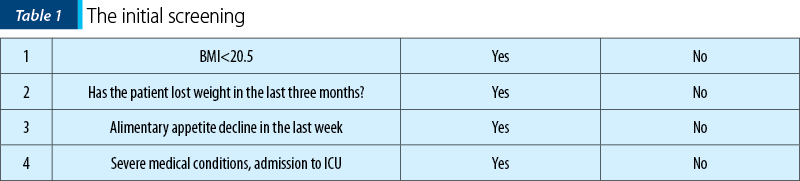
If the answer is ‘No’ to all these questions, the screening will be repeated after one week. If the answer is ‘Yes’ to all these questions, the patient is considered with increased nutritional risk.
In hospitalized patients there is carried out the final screening, which has two components: nutritional status and disease severity.
For the nutritional status, the scoring system is as follows: score 0 if the patient didn’t lose weight and has normal appetite; score 1 if the patient has lost more than 5% of the body weight in the last three months and the alimentary intake has been below 50-70% of the necessities in the last week; score 2 if the patient has lost more than 5% of the body weight in the last two months or has a BMI between 18.5 and 20 associated with the altering of the general condition and an alimentary intake between 25% and 60% of the necessities; score 3 if the patient has lost more than 5% of the body weight in one month or more than 15% in three months or he has a BMI less than 18.5 associated with the altering of the general condition and an alimentary intake below 25% of the normal level (Table 2).
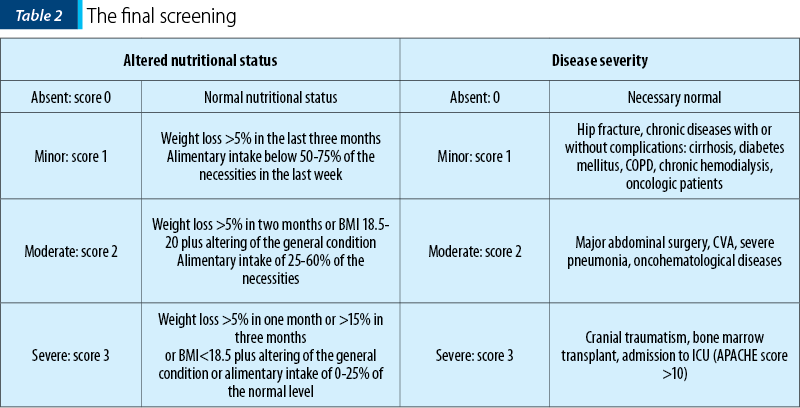
For assessing the disease severity, the scoring system is as follows: score 0 for a minor disease; score 1 for patients with hip fracture, chronic diseases with or without complications (cirrhosis, diabetes mellitus, COPD, chronic hemodialysis, oncology patients); score 2 in major abdominal surgery, cerebral vascular accident (CVA), severe pneumonia, oncohematological diseases; score 3 in patients with cranial traumatism, bone marrow transplant, admission to ICU (APACHE score >10) – Table 2.
For patients older than 70 years, one point is added to the final score.
Interpretation: a score ≥3 means a patient with nutritional risk who necessitates a therapy plan; a score <3 means a patient who necessitates weekly reevaluation.
This draws the attention to the relationship between preoperative malnutrition and the rate of complications and postoperative mortality. The nutritional deficit is often undiagnosed(14).
NRS is validated as predictive factor of morbidity associated to surgical interventions by prospective studies (EuroOOPS, 2008; Schwegler, 2010)(14). Weight loss and decreased albumin level (<3 g/dl) are other parameters with a good predictive value(10). Another study (Kuppinger, 2012), cited by ESPEN in 2017(14), revealed a good appreciation of the nutritional status using as assessing parameter only the appetite decline before hospitalization in patients who underwent abdominal surgery. Other authors use modified nutritional screening scores(12).
The concept of preparation before surgery enters in another era, becoming an essential stage for preventing postoperative complications. The assessment of nutritional status and its optimization with nutritional therapy introduced 10-14 days before surgery in patients with insufficient alimentary intake don’t associate significant biological modifications. Some authors recommend a program of “prehabilitation”, which includes physical exercises and respiratory kinetotherapy in order to improve the muscular function(14).
It is important to underline that in patients without denutrition it is not indicated the protein calorie supplementation even after surgery, if the restart of a sufficient per os administration is expected in less than seven days.
In other patients, an energetic supplementation of 25 kcal/kg and 1.5 g of amino acids in 24 hours, preferably on enteral administration, must be continued until the alimentation will provide more than 60% of the necessities.
Finally, we must take into consideration that not all oncology patients with malnutrition can receive nutritional therapy. In esogastric cancers especially, but also in cancers with other localizations, different complications of the disease can be associated, such as digestive hemorrhages, stenoses, occlusions, massive digestive fluid losses, and tumor necroses with associated sepsis. In these cases, only minimal re-equilibrations are allowed, the temporization of surgery leading to the supplementary alteration of the patient’s condition rather to improving the metabolic status. The pathological context represented by comorbidities, such as heart failure, hepatic insufficiency, uncontrolled diabetes mellitus, blood dyscrasias and shock, can limit or contraindicate the protein calorie support, either parenteral or enteral.
Conclusions
Performing the routine nutritional screning in all oncology patients planned for surgery, followed by preoperative nutritional therapy, is essential for preventing postoperative complications.
Conflict of interests:
cancernutriţieoncologie geriatrică
IOCN: ministrul Sănătății a vizitat o caravană mobilă de screening pentru cancerul de sân
119.000 de femei sunt vizate pentru screening în cadrul acestui proiect la IOCN.
...
CNAS: traseul complet al pacientului cu cancer pulmonar este decontat
Punctul de pornire este, de regulă, medicul de familie, care evaluează simptomele și antecedentele medicale.
...
CMSR: programul OralOncoCheck continuă și în 2027
Identificarea suspiciunii de cancer oral este numai primul pas de diagnostic prezumtiv.
...