Din aceeași categorie
Introduction
Postpartum haemorrhage (PPH) is a medical and obstetrical emergency and it represents one of the top causes of maternal morbidity. Globally, 29.3% of maternal deaths and 26.7% of severe adverse maternal outcomes are related to haemorrhage(1).
The most recent definition of PPH was given by the American College of Obstetricians and Gynecologists, in 2017, representing the cumulative blood loss over 1000 mL, regardless of route of delivery and signs or symptoms of hypovolemia(1).
In healthy pregnant and postpartum women, compensatory mechanisms developed in pregnancy (increase in cardiac output, heart rate and blood pressure) that prevent changes in vital signs until a large amount of blood is lost (usually >1000 mL)(1). In this case, we need a new method to appreciate the blood loss before the symptoms of hypovolemia appear, and this method is the shock index (SI).
The SI is calculated dividing the HR (heart rate) to SBP (systolic blood pressure), and it has been proposed as an earlier marker of compromise. Initially, it was mainly used for non-specific shock, trauma or sepsis in non-pregnant populations(2), but now it is used in evaluating the postpartum bleeding evaluation.
Method
We conducted a literature review study in order to assess the predictive value of SI in women with postpartum haemorrhage (PPH) and we searched PubMed, Medline and medical texts pertaining to SI in PPH up to January 2019.
Results
We found two studies, including 1191 patients with PPH and 21853 non-pregnant patients. The shock index is used mostly to identify the patients who need blood transfusion.
Discussion and conclusions
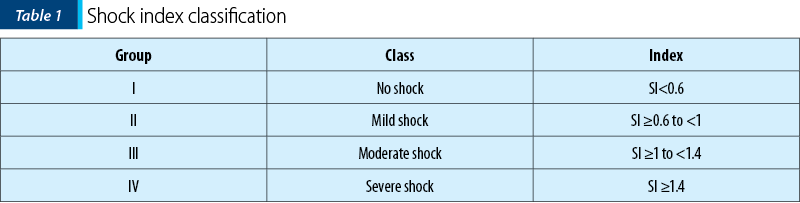
Mutschler et al. included 21,853 non-pregnant patients in his study and concluded that the SI was divided into four groups: group I (SI<0.6), group II (SI ≥0.6 to <1), group III (SI ≥1 to <1.4) and group IV (SI ≥1.4) – Table 1. The increasing transfusion requirement varies from one blood unit in group 1 to 21.4 in group IV(3).
For pregnant women, these values are different due to the cardiovascular modifications mentioned before, and the values of SI increase simultaneously with the weeks of gestation: from 0.756±0.127 at 12 weeks or fewer to 0.831±0.144 at 28-32 weeks(4). Other studies show that the normal ranges were situated between 0.7 and 0.9(5).
Further studies reveal that for all the non-pathological pregnancies, during the entire pregnancy, the SI should be 0.75-0.83; in the postpartum period the SI should be between 0.52 and 0.89, and it can also be influenced by the epidural anesthesia or the use of ergometrine. Up to 20% of the normal pregnancies can present a SI over 0.9, without any pathological implications(1).
A study that involved 958 women with PPH revealed that SI was an important predictive factor of morbidity and death, the value of 0.9 being the inferior limit of SI for patients who needed intervention in the postpartum period. From 958 patients involved, 60 patients (6.3%) had a SI under 0.9(1). Another study that involved 233 patients with PPH revealed a significant value of the SI between 0.8 and 1.15. A number of 202 women (86.7%) had a SI level over 0.7, and 137 (58.8%) had a SI level over 0.9. The women with SI level under 0.9 were not admitted in the intensive care unit. A SI level over 1.7 represents a severe situation which requires major interventions(2).
In conclusion, SI is a good strategy to act earlier in women who are at high risk for adverse outcome. As the two studies showed, the SI value of 0.9 should be the alarm value. Furthermore, SI can be easily calculated, and it can be applied even in not so well-resourced medical centers.
Conflict of interests: The authors declare no conflict of interests.
hemoragie post-partumindexul de şocpierdere de sânge