Din aceeași categorie
Opinii şi recomandări curente pentru utilizarea meşei în chirurgia ginecologică – review al literaturii
Introduction
Being the leading cause of gynecological diseases, ovarian tumors are estimated as the fifth cause of death among women(1). Furthermore, the five-year survival rates of advanced condition after radical surgery still remain below 30%(2,3).
Interestingly, the ovarian tumors are predominantly seen in postmenopausal women, the reproductive age patients representing 20% of the total number of patients(4-6). Many of the published studies are institutional-single center analyses which enrolled only a small number of patients and the majority of reports were not relating to general population(7,8). Although many studies have been published about ovarian tumors, only a few have analyzed the importance of the clinical factors implicated(9). And currently, only a limited number of studies regarding detailed surgical staging have been published, including the survival rate of younger women diagnosed with ovarian tumors(10).
Although for most of the early-detected cases the treatment consisted in total hysterectomy, infracolic omentectomy, peritoneal biopsy and lymph node extraction, maximal cytoreductive surgery remains the basic surgery treatment for advanced ovarian tumors(11-14). Anyway, most of the cases are presented in advanced stages, considering the asymptomatic features of the disease, in which the five-year survival was only 30%(15).
Besides many other tumoral markers involved in diagnosis and prognosis of ovarian cancer, serum cancer antigen (CA)125 is generally used in the differentiation of other pelvic mases(16,17). This marker can be evaluated as a prognostic factor, before the initiation of any treatment(18). However, the implication of serum CA125 levels in ovarian cancer prognostic is more controversial, considering other variabilies such as staging(19).
The present study was undertaken on 237 ovarian cancer patients, in which we proposed to determine the risk associated with age, parity, menarche and menopause precocity, gynecological pathologies, serum CA125 tumoral marker, tumor, lymph node and metastasis (TNM) staging, and surgical treatment associated with improved five-year survival outcome.
Materials and method
The present study was performed on patients with ovarian tumor who were referred to surgery and obstetrics & gynecology clinics of “St. Andrew the Apostle” County Emergency Clinical Hospital, Constanţa, Romania, over a period of five years, between January 2011 till December 2015.
Our study group consisted in 237 patients with malignant ovarian tumors who were selected from a total of 985 ovarian tumors which presented at least one ovarian tumor formation with a 5-mm minimal diameter. All patients underwent surgery as primary treatment. The study was approved by our institution, and the informed consent from each patient was taken. The inclusion criteria were as follows: age between 15 years old and more than 60 years old at the time of the initial diagnosis, all stages of ovarian neoplasms, and receiving only surgical treatment.
We excluded women with a history of tubal sterilization techniques, pelvic radiation therapy either pre- or postoperatively, including pregnant women. We also excluded women with benign and/or borderline tumors.
The tumor stage and histological diagnosis of each case were determined according to the criteria of the International Federation of Gynecology and Obstetrics (FIGO), including TNM staging according to UICC – TNM(20).
There were analized: age, parity, menarche and menopause precocity, gynecological pathology association, serum CA125 when positive if the levels were elevated (≥35 U/mL)(21), TNM staging, surgical treatment by staging and the survival rates after five years. The characteristics were expressed in percentages. Descriptive statistics was used in order to correlate the data.
Results
Distribution by age
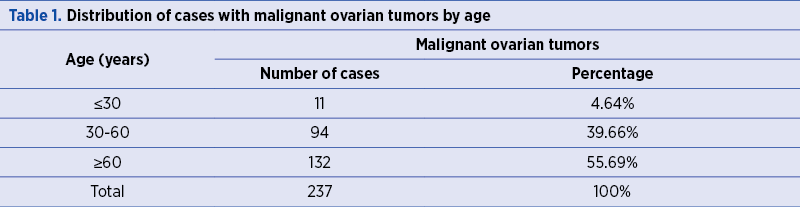
Regarding the age of the patients, most malignant ovarian tumors were encountered in the age group over 60 years old, follwed by 30-60-year-old patients, with 39.66% (Table 1).
Parity of the patients
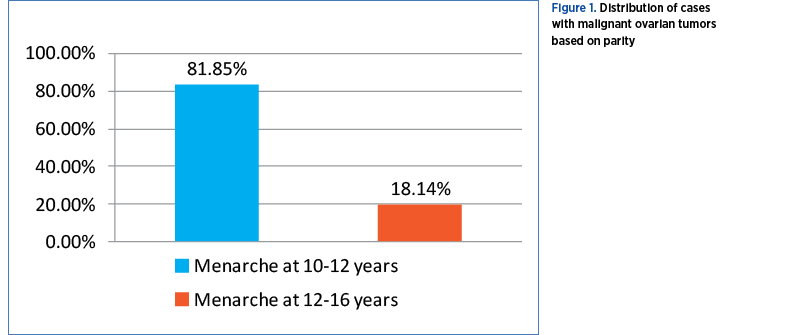
Out of the 237 studied women, 194 (81.85%) were multiparous, and 43 (18.14%) were nulliparous (Figure 1).
Age of menarche
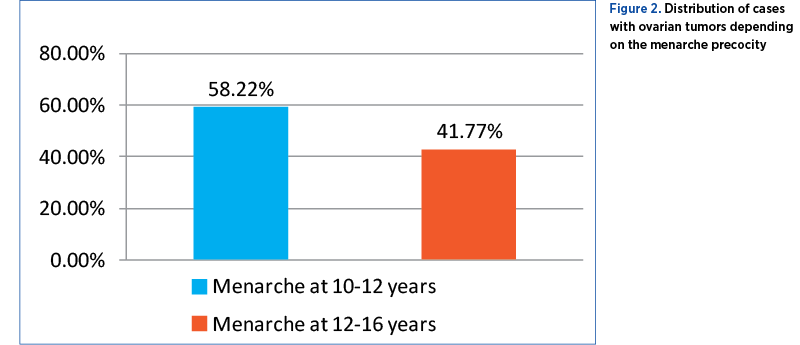
Malignant tumors occurred in 138 patients (58.22%) having the menarche at 10-12 years old, and in 99 patients (41.77%) with menarhe at 12-16 years old (Figure 2).
Menopause precocity
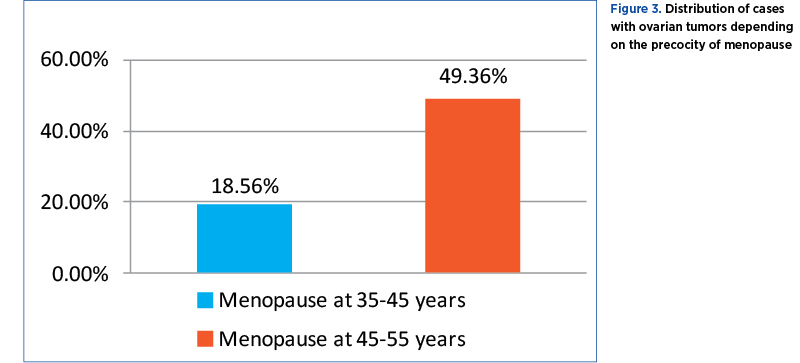
Of the 237 cases analyzed, 161 patients were menopausal, with the remaining 76 being in a younger age group. Out of these, 44 (18.56%) had menopause between 35 and 45 years old, and 117 (49.36%) patients had menopause between 45 and 55 years old (Figure 3).
Association of gynecological pathology
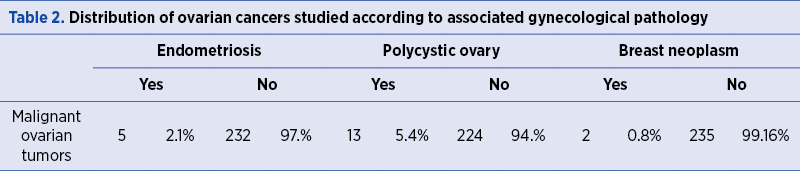
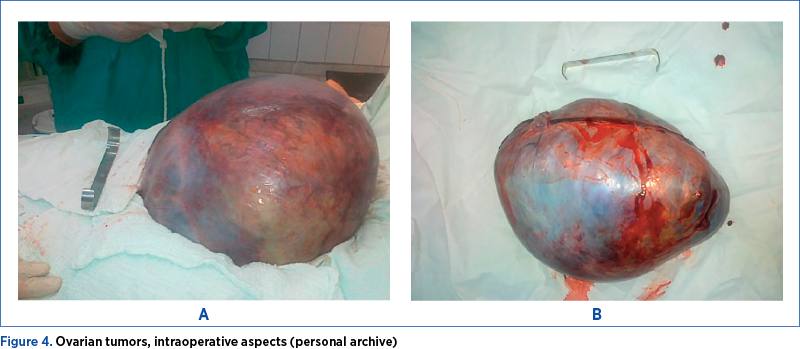
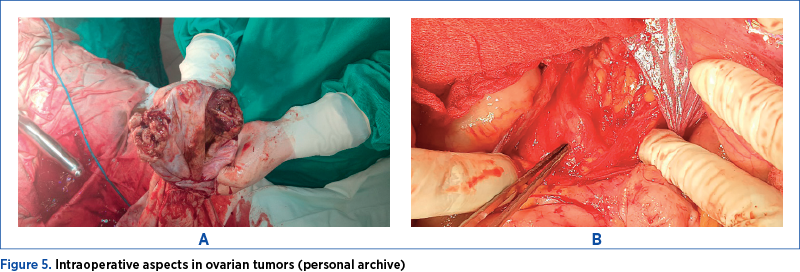
Malignant ovarian tumors were associated more with polycystic ovaries, in 13 patients (5.48%), followed by endometriosis in five patients (2.10%), and breast cancer in two patients (0.84%) (Table 2, Figure 4, and Figure 5).
Serum CA125 tumoral marker
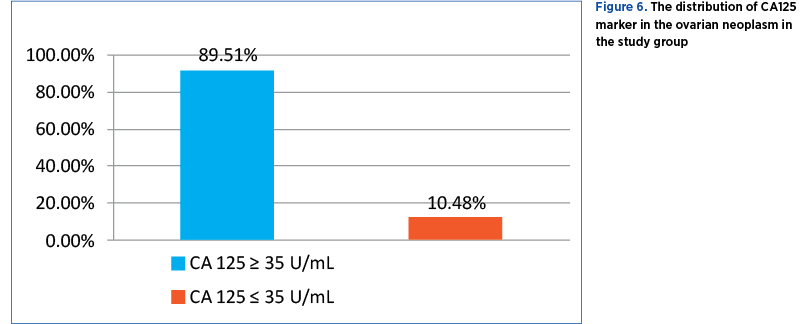
Only 143 cases of malignant tumors were tested for serum CA125 tumor marker. Out of these, 128 (89.51%) patients had elevated values (CA125≥35 U/mL) and 15 (10.48%) patients had normal values (CA125≤35U/mL) (Figure 6).
TNM staging
In stage I, there were 38 malignant ovarian tumors (16.03%), of which five were in stage Ia, 14 were in stage Ib, and 19 were in the stage Ic. Stage II represented 26.58% of all ovarian malignancies: 17 cases in stage IIa, 27 cases in stage IIb, and 19 cases in stage IIc. In the third stage, 36.70% of malignant ovarian tumors were classified as follows: 24 were in the stage IIIa, 34 in stage IIIb, and 29 in stage IIIc. In the fourth stage, there were 49 malignant ovarian tumors (20.67%) included (Table 3).

Surgical treatment
The therapeutic strategies have been chosen according to the TNM stage. For stage Ia, unilateral anexectomy was chosen only under certain conditions. Adjuvant chemotherapy was not necessary in all cases. Second-look laparoscopy was practiced at six months per-pelviscopic and was addressed to patients who apparently responded fully to chemotherapy or just to surgical treatment. This allows an assessment of residual risk and consolidation treatment, directing subsequent attitudes. Thus, the following intervention was generally performed for the first and second stages: total hysterectomy with bilateral anexectomy and omentectomy.
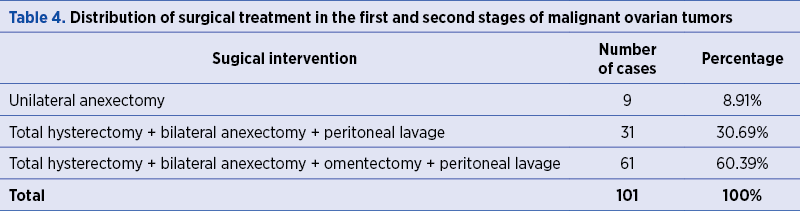
Therefore, malignant ovarian tumors in the first and second stages of development have received the following surgical treatments according to the TNM stage: unilateral anexectomy in 8.91% (9 cases); total hysterectomy with bilateral anexectomy and peritoneal lavage in 30.69% (31 cases); total hysterectomy with bilateral anexectomy, omentectomy and peritoneal lavage in 60.39% (61 cases) – Table 4.
For the third and fourth stages, radical interventions were performed: hysterectomy with bilateral anexectomy with omentectomy, to which the large locoregional and visceral extensions could be added.
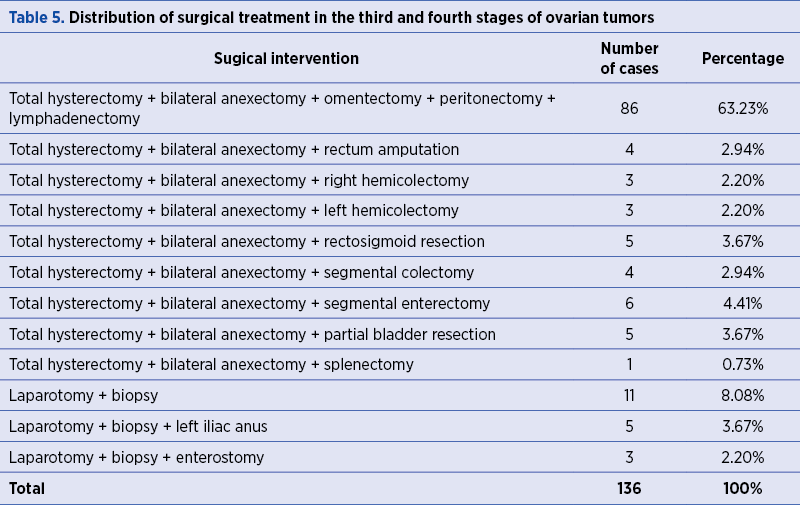
Ovarian cancers in the third and fourth stages were subjected to the following surgical interventions according to the TNM stage: total hysterectomy with bilateral anexectomy, with omentectomy, with peritonectomy and lymphadenectomy in 86 cases (63.23%); total hysterectomy with bilateral anexectomy and rectal amputation in four cases (2.94%); total hysterectomy with bilateral anexectomy and right hemicolectomy in three cases (2.20%); total hysterectomy with bilateral anexectomy and left hemicolectomy in three cases (2.20%) and total hysterectomy with bilateral anexectomy and rectosigmoid resection in five cases (3.67%) – Table 5.
Survival rate after five years depending on age
In the age group under 30 years old, there were 11 women (Ia and Ib stages) with malignant tumors and all survived at five years (100%). The 30-60 age group counted 94 cases with ovarian cancer. Out of these, 50 patients (52.63%; Ic, IIa, IIb and IIc stages) survived at five years. Patients over the age of 60 were 132, of whom only 26 (19.69%; IIIa, IIIb, IIIc, and IV) survived at five years.
Discussion
Many studies involving the clinical risk profile of the malignant tumors are still in debate. Until present, many reports have showed the importance of younger age in the disease prognostic, with better outcome and survival rates(5,22). In this respect, other studies have found opposite results, considering that age was not an independent factor after adjusting the tumor stage(23).
In the present study, we proposed to perform a large population-based study to evaluate the clinical characteristics between younger and older patients with malignant ovarian cancer. Furthermore, we sought to show if younger age is an important factor for improved survival rate, among other features like parity, menarche and menopause, gynecological pathology association, serum CA125 tumoral marker, TNM staging, and surgical treatment.
In our study, the malignant tumors occurred in 58.22% of the patients having the menarche at 10-12 years. In this respect, one study among women population reported lower risk with late age at menarche (i.e., after the age of 18 years old)(24), while another study observed a slightly increased risk with late age at menarche(25). The inconsistent features regarding age at menarche and menopause could show differences and misclassification bias, or differences in study population(26).
Ovarian cancer is predominantly a disease with a median age at diagnosis of 65 years old, most of the women being at menopause. However, approximately 12% of cases occur in women aged less than 45 years old(22). Regarding our study population, it was not surprising to find that the women aged less than 30 were more likely to be in the first stage, and the higher prevalence of malignant ovarian cancer was seen at ages more than 60 years old (55.69%).
Interestingly, another study showed that preoperative CA125 marker is a prognostic feature in advanced malignant ovarian tumors(27). However, the role of serum CA125 remains unknown(28). Serum CA125 represents a glycoprotein expressed in the epithelium lining of body cavities(29), and our study revealed elevated values in majority of patients (5.48%) which were positively correlated with advanced stages. These values could also predict advanced extraovarian disease before surgery(29).
The choice for surgical treatment, especially in early stages of ovarian cancer, usually consist in aspiration of ascites, hysterectomy, bilateral salpingo-oophorectomy, infracolic omentectomy, bilateral pelvic and para-aortic lymph node sampling(30). Hysterectomy and bilateral salpingo-oophorectomy are more important considering the fact that uterine serosa and endometrium are often sites of occult metastasis(31,32). In the present study, the majority of the patients were in stage III TNM (36.58%), and the higher prevalence of surgical treatment was represented by total hysterectomy with bilateral anexectomy and segmental colectomy/enterectomy.
In our study, the higher survival rate at five years of follow-up was seen in patients under the age of 30 years old, comparing with the rest of the patients. The results are similar with those of the study conducted by Rodriguez and contributors(6) on younger women with ages less than 25 years old and ovarian tumors, which have showed a survival rate of 70% over the five-year period.
Greenlee el al. showed that the first stage of ovarian cancer was associated with a five-year survival rate of 62-85%(33). Moreover, there weren’t seen other negative effects in the patient’s children(34). In the case of patients at fertility ages, they should be informed about surgery consequences and about further fertility preservation therapy(35).
The specific risks in the ovarian cancer in earlier stages before subsequent chemotherapy must be considered and further discussed individually. In the cases when patients undergo chemotherapy, they should wait for about six months in order to eliminate the negative effects on the oocytes(36). Therefore, careful consideration of the ovarian cancer risk profile should better increase the variability in the disease incidence.
Conclusions
In the present study, we sustained the need to create a screening for patients at risk of ovarian cancer which present higher age, multiparity, early menarche, polycystic ovaries association and higher serum CA126 marker values. Furthermore, the prognosis of ovarian cancer showed to be dependent on the clinical profile, in order to better predict the appearance of the disease in early stages.
Conflict of interests: The authors declare no conflict of interests.
tumori malignecancer ovariantratament chirurgicalmanagement
Curs de Management Medical, organizat de MedicHub Media
Dacă sunteți la început de drum, vă recomandăm pachetul Essential. Dacă aveți deja o afacere și urmăriți dezvoltarea acesteia, Professional sau Executive oferă cele mai multe beneficii.
...
Ghidurile românești pentru cancerul ovarian trebuie actualizate
În ultimii șapte ani recomandările internaționale pentru tratarea cancerului ovarian s-au modificat semnificativ. Acestea ar trebui să se regăsească și în ghidurile utilizate în România, subliniază șef de lucrări ...

INSP: proiect despre managementul deșeurilor medicale
Uniunea Europeană finanțează managementul durabil al deșeurilor rezultate din activitățile medicale.
...