Din aceeași categorie
Background and aims
Medical students are a risk group for mental health difficulties(1), with high levels of stress and high prevalence of anxiety and depression(2,3,4). The level of stress and depression during medical training are significantly higher than before the onset of medical training(1). Thus, 4.4% of medical students have anxiety, 1.9% panic disorder, 4.7% major depression, 5.8% other depressive symptoms, and 15.7% have psychosomatic complaints(5). Poor sleep awareness, poor sleep quality, and sleep deprivation (sometimes self-imposed) are also common in this population. Sleep-related difficulties may be a result or a precipitating factor of stress(6).
External factors such as medical school workload, family expectations(7), the demand to develop their professional identity(8), and internal factors such as perfectionism potentially leading to self-imposed excessive workload are associated with mental health difficulties in medical students(7).
However, only a small proportion of medical students seek help, because of the perceived social pressure that they should be ‘invincible’(9), while 10.7% of the medical students reported regular psychotropic substance use, for different reasons: “to calm down”, “to improve their sleep”, “to elevate mood”, “to improve cognitive performance”(5).
Medical training is a suboptimal environment for the students’ psychological health(1,10) due to high academic standards(11,12), study burden(2,13), frequent examinations(12), busy schedule(2), competitive environment(11,14) and rigors of medical education(15). In addition to medical student status, foreign medical students are more vulnerable to mental health difficulties, due to major life changes(2), temporary migration(16), homesickness(17), language barriers(18), sociocultural differences(19), challenges in maintaining religious practices(20), impaired sense of shared social identity(8,10), low peer support(14).
Due to all these issues, studies on student well-being and institutional efforts of universities have increasingly focused on mental health awareness in foreign medical students.
The current study aims to assess the relationship between the level of perceived stress and reported well-being in a sample of foreign first year medical students enrolled in Romania.
Method
Study population. The target population consisted of 201 students enrolled in the first year at the Faculty of Medicine, English Section, at “Iuliu Haţieganu” University of Medicine and Pharmacy, Cluj-Napoca, Romania, in the 2015/2016 academic year. Between May 1st and May 15th 2016, 150 of these students were approached; 120 agreed to participate in the study, and 91 filled in the questionnaire. One questionnaire was excluded from the data analysis due to the student’s age (48 years), which deemed him an outlier.
The mean age of participants was 20.9 ± 3.7 years. 52.7% of participants were women; based on geographic criteria, 71.4% of participants were Europeans.
Instruments. The Perceived Stress Scale (PSS) was used to measure the level of perceived stress. The 14-item self-assessment version of PSS is the most widely used measure of perceived stress(21). Eighty-one students provided complete data for this scale.
The 5-item World Health Organization’s Well-Being Index (WHO-5) was used to assess the perceived well-being. The WHO-5 questionnaire is a brief, comprehensive and easy to employ self-assessment measure for psychological well-being(22). Eighty-nine students provided complete data for this scale.
The statistical analysis was carried out with the IBM Statistical Package for Social Sciences™ (SPSS) version 20.0. Non-parametric tests Kolmogorov-Smirnov and Mann-Whitney U were used to test for distribution and compare variables across two samples. Spearman’s correlation was used to assess the correlation between non-normally distributed discrete variables.
Results
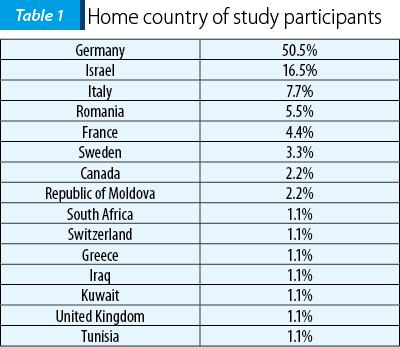
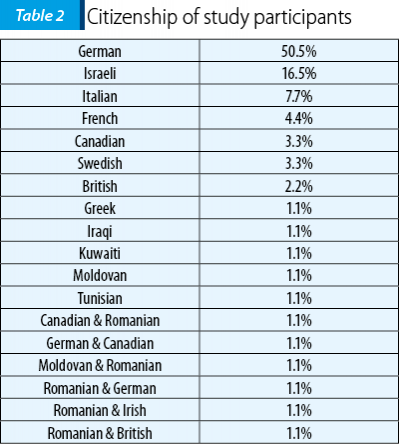
Most of our study participants were born in Germany (see Table 1). The most frequent citizenship was also German; some participants reported double citizenship (see Table 2).
Female students reported a significantly higher level of perceived stress than male ones, as measured by PSS total score: 29.05 ± 6.46 vs. 24.19 ± 8.19 (p<0.01 – Mann Whitney U). However, levels of reported well-being were similar in female and male students included in our study, as measured by WHO-5 total score: 15.21 ± 4.42 vs. 15.93 ± 3.93 (p>0.05 – Mann Whitney U Test).
European and non-European students reported similar levels of perceived stress (PSS total score 26.73 ± 7.18 vs. 27.6 ± 9.34, p>0.05 - Mann-Whitney U Test), and well-being, respectively (WHO-5 total score 15.73 ± 3.32 vs. 15.08 ± 5.9, p>0.05 - Mann-Whitney U Test).
39.6% of participants considered themselves religious persons, while 59.3% identified as not religious. Self-declared religious students and self-declared non-religious ones reported similar levels of perceived stress (PSS total score 26.55 ± 7.03 vs. 26.88 ± 8.16, p>0.05, Mann-Whitney U Test), and well-being (WHO-5 total score 16.08 ± 3.46 vs. 15.20 ± 4.66, p>0.05 - Mann-Whitney U Test).
The level of perceived stress and well-being were negatively correlated both in male participants (Spearman’s R=-0.662, p<0.01) and female ones (Spearman’s R=-0.594, p<0.01), both the religious ones (Spearman’s R=-0.593, p<0.01), and non-religious ones (Spearman’s R =-0.594, p<0.01). The strongest negative correlation between perceived stress and well-being was found in non-European participants (Spearman’s R=-0.85, p<.01), while the least strong was found in European ones (Spearman’s R=-0.542, p<0.01).
Discussion
The current study shows that female foreign first year medical students report higher levels of stress and similar levels of well-being, compared with male ones. Moreover, the level of perceived stress has a higher negative impact on well-being in male participants of our study. These results may be explained by the various gender-specific mediating factors of stress. Some studies show differences in coping mechanisms most frequently used by female and male medical students: denial and behavioral disengagement for women, and self-blame for men(23).
Our study also shows that the level of stress has a significant negative impact on well-being regardless of geographical area of origin. Nevertheless, the highest negative impact of perceived stress on well-being was observed in non-European participants. This finding may be explained through differences in risk factors for stress in non-European students. Several studies acknowledge the lack of social and family support(14), homesickness(17), adjustment difficulties(8,10,16,18,19), academic difficulties(11,12) as risk factors for stress in international students. These may result in higher levels of stress, loss of social contacts, and reduced quality of life(18). Moreover, foreign medical students may experience adjustment issues due to acculturation(16). Protective measures could be providing applied medical language courses, and programs for fostering connectedness and intercultural exchanges(18).
Our study also shows that the level of stress has a significant negative impact on well-being both in religious and non-religious students. Other studies, however, cite religious affiliation as one of the most frequent coping mechanisms used among physicians(24). Religious/spiritual medical students reported less frequent conflicts within the medical team, less work-life imbalance and less emotional stress arising from patient suffering; on the other hand, they may experience more inner struggle, self-doubt, or inadequacy generated by differences between medical training curriculum and personal religious beliefs(25). Other studies show that spiritual and existential well-being are associated with lower levels of perceived stress and depression(26).
An increasing body of data draws attention towards the mental health status of care providers. A recent study shows that depression scores decrease with every year of medical training(9). This may be due to the fact that years of experience and effectiveness of coping are positively correlated in physicians. Given the fact that most medical students are young adults with little experience, their coping mechanisms may be less effective, compared to experienced physicians. Maladaptive coping strategies, such as self-blaming, denial, and giving up, were cited as main predictors of depression, anxiety, and distress(12).
Mental health of medical trainees is a public health issue from enrollment and the first years of medical training, and this is when prevention should begin. Some universities have already started implementing mental-health supporting changes in the educational programs (such as adjustment of the curricula and the human anatomy exam difficulty, a pass/fail grading system in preclinical years, longitudinal and shorter electives), with good outcomes. Additional strategies focused on personal level, by implementing a resilience and mindfulness program, and organizing social events for all medical students(27). Mental health programs should also focus on modern technology-based cognitive behavioral therapy(28), and increasing emotional intelligence. Higher levels of emotional intelligence are associated with higher levels of satisfaction and lower perceived stress levels among all medical students, and better academic performance amongst final year medical students(29). Lastly, but maybe the most important intervention, mental health first aid courses and anti-stigma programs improved the quality of first aid intentions towards a person experiencing depression, decreased stigmatizing attitudes and desire for social distance from a person with depression, and increased mental health literacy and confidence in providing help to someone who is experiencing depression(30).
The current study has several important limitations. Firstly, the sample was divided into Europeans and non-Europeans based on geographical criteria. Nevertheless, some states – e.g., Israel (where 16.5% of the participants were from) – are European Union trade agreement members, so they are spared of some bureaucracy issues regarding official documents for travel and stay, which could in turn generate less stress compared to students from other non-European states. The study sample was small and the study design was cross-sectional. Also, the questionnaire was in English; all assessed students study in English, but with few exceptions this is not the first language of participants.
The originality of the study consists in the fact that it addresses the relationship between perceived stress and well-being in a sample of foreign medical students by gender, geographical area of origin and religiosity. A larger sample, an assessment of number and type of stress factors, paired with measures of personality and coping mechanisms and a prospective study design may provide a comparative assessment of factors mediating stress and well-being before and after the onset of the medical training. Further data on how these factors combined with coping mechanisms impact well-being may support specific mental health prevention strategies for this academic population.
Conclusions
The current study supports that the negative relationship between perceived stress and well-being of first year international medical students in Romania is mediated by gender and non-European origin. Our study did not ascertain any difference regarding the relationship between perceived stress and well-being of religious vs. non-religious first year international medical students in Romania.
Acknowledgment
The authors wish to thank the students who participated in this study.
studenţi mediciniştistudenţi străinistresstare de binesănătate mintală
Studiu: jumătate dintre femeile care lucrează acuză un nivel de stres mai mare ca în urmă cu un an
Jumătate dintre femeile care lucrează spun că se confruntă cu un nivel de stres mai mare decât în urmă cu un an. O pondere similară, în creştere faţă de 2023, declară că angajatorii nu le susţin în eforturile de a-şi echilibra raportul dint...
SCJU Sibiu: ateliere de management al stresului şi de comunicare în situaţii dificile
În perioada 22-24 aprilie 2024, la Sibiu, zeci de profesionişti din domeniul sănătăţii beneficiază de ateliere de management al stresului şi burnoutului, precum şi de comunicare în situaţii dificile....