Din aceeași categorie

Introduction
Vaping is the act of inhaling and exhaling aerosols that are produced by electronic cigarettes or other similar products. These are often called vapors, hence the term “vaping”. Electronic cigarettes – or e-cigarettes – produce these aerosols by heating a liquid that usually contains nicotine, aromatic flavors and other chemical compounds. The people nearby the user can also passively breathe these aerosols(1).
Many young people have come to understand that smoking is a bad thing, but most of them feel that e-smoking is a safer alternative. According to the Center for Disease Control and Prevention (CDC), vaping is popular among all young people, many high school students participating in this “phenomenon” every year. About 2.1 million middle school and high school students were users of e-cigarettes in 2017, and since then the numbers are increasing(2). However, e-cigarette sales data show an even greater prevalence of e-cigarette use than the one from the surveys.
JUUL® is one of the most popular vaping brands that has multiple flavors and looks like a flash drive and can be charged to a computer by using the USB port. What is less known is that JUUL® offers high levels of nicotine, making the product extremely addictive and dangerous. The company that makes and sells JUUL® recently exceeded its turnover of 10 billion dollars in record time, faster than many other popular companies. The sales of this brand now make up more than half of the e-cigarette market(3).
Studies have shown that, as a result of the efforts of parents, doctors and information campaigns, the number of adolescents trying combustible cigarettes decreased from 70% in 1991 to 58.4% in 2003 and even further to 28.9% in 2017. On the other hand, electronic cigarettes have registered a rapidly increasing prevalence(4).
A study performed by the University of Michigan revealed an increase in the number of students who vape regularly from 2015 to 2018, for each age group: from 8% to 10% in eight-grade students, from 14% to 22% in tenth-grade students, from 16% to 27% in twelfth-grade students, but also from 14% to 21% in college students(5).
The European Pediatric Association (EPA-UNEPSA) raised the attention on the increasing use of e-cigarettes among teenagers, by curiosity or for quitting smoking, but with potential health risks. Public health prevention programs should include information about this phenomenon and pediatricians should be in the first line of this prevention activity(6).
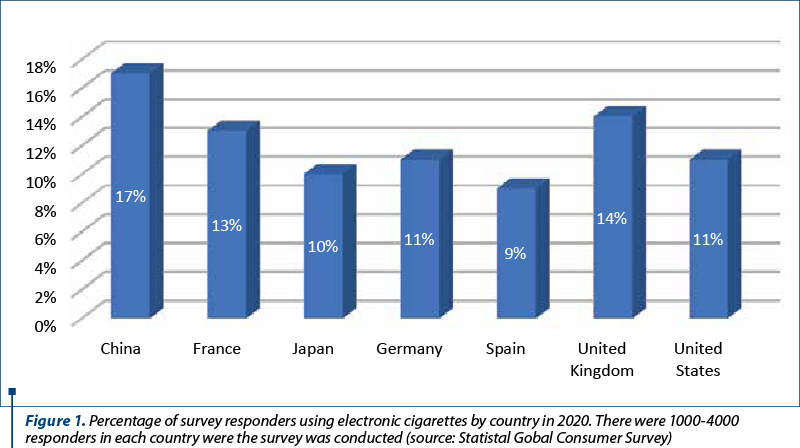
Cigarettes, pens or USB flash drives
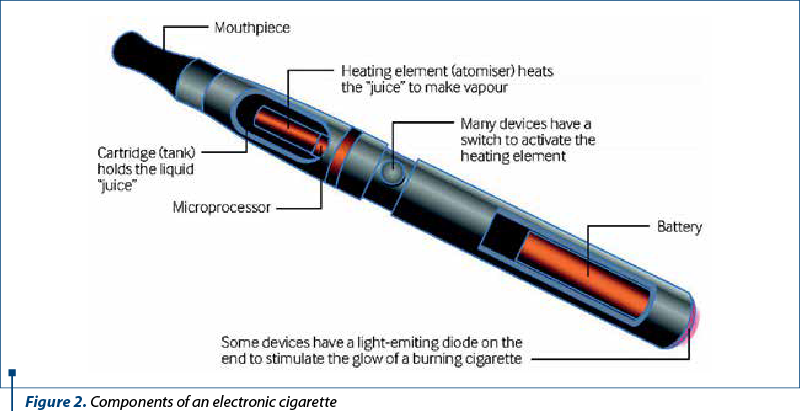
Electronic cigarettes appeared on the market in 2007. Instead of smoking, they produce aerosols that look like water vapors. Any vaping device has a similar system: a mouthpiece, a battery, a cartridge or a tank that contains e-liquid, and a heater. In short, the process that makes everything work is this: the resistor is heated by the battery and turns the e-liquid into vapor, which is then inhaled and exhaled(5).
Vaping devices come in a variety of forms:
1. Disposable, with cigarette-like aspect (cigarette-shaped – they can be used only once or the battery can be recharged and can be used several times).
2. Hookah-Pen®, Vape-Pen® or Ego® (with a battery and electronic liquid tank).
3. JUUL E-cigarette® (refillable with USB charger), one of the most used types in the United States.
4. Advanced personal modes or vaporizers (customizable; with custom battery and tank)(7).
What do e-cigarettes contain?
Smoke from e-cigarettes is different from cigarette smoke. While cigarette smoke results from the burning of tobacco and other cigarette additives, e-cigarettes produce “smoke” by heating a liquid. This results in a chemical-filled aerosol which is then inhaled. Since they do not contain combustion by-products (many of which are carcinogenic), e-cigarettes do offer an improvement over traditional cigarettes from a point of view. But we need to have the full view of a product, not just its positive aspects.
Propylene glycol and glycerine are abundant in e-cigarettes and although they are generally perceived as relatively harmless, the long-term effects of heavy exposure to these substances are unknown(5).
Most e-cigarettes contain nicotine, the addictive drug in regular cigarettes, cigars and other tobacco products. A recent CDC study found that 99% of e-cigarettes sold in evaluated locations in the United States contain nicotine. Some e-cigarette labels do not reveal nicotine, and some e-cigarettes marketed as containing 0% nicotine have been shown to contain nicotine(8).
Electronic cigarette devices can also be (and are already, especially in the United States) used to deliver marijuana and other drugs(9).
Is vaping really that dangerous for teenagers?
Nicotine use in adolescence can damage parts of the brain that control attention, learning, mood and impulse control. Nicotine may also increase the risk of future dependence on other drugs or substances, and therefore the shift from e-cigarettes to traditional ones in children and adolescents is possible(10).
In addition to nicotine, which is present in most e-cigarettes and is addictive, studies have also revealed the carcinogenic effect of e-cigarettes. The excretion of the metabolites of acrylonitrile, acrolein, propylene oxide, acrylamide and crotonaldehyde was significantly higher in e-cigarette users compared to controls. The authors of the same study concluded that, “although e-cigarette vapors may be less dangerous than tobacco smoke, we cannot say that e-cigarette vapors are safe because many of the volatile organic compounds we have identified are carcinogenic. Messages to adolescents should include warnings about the potential risk of toxic exposure to carcinogens generated by these products”(11).
E-cigarette users experience increased oxidative stress and an increase in the release of inflammatory mediators. Vaping also induces platelet activation, aggregation and adhesion, which consist a risk for cardiovascular patients, and not only. All these changes are associated with an increased risk of cardiovascular disease. Even though research is still ongoing in this field, it is better to be cautious while waiting for evidence(12).
Currently, four imaging patterns correlated with vaping-attributed pathology are reported: acute eosinophilic pneumonia, diffuse alveolar damage, organizing pneumonia, and lipoid pneumonia. However, lung disease associated with vaping has yet to be recognized as a distinctive terminology in the field of radiology(13). Also, hemophagocytic lymphohistiocytosis (HLH) and macrophage activation syndrome (MAS) can be caused by vaping. Recently, in addition to the complications and hospitalizations caused by the consumption of electronic cigarettes, the first cases of death in people without other morbidities began to appear(14).
In July 2019, the Wisconsin Department of Health Services and the Illinois Department of Public Health launched a coordinated public health investigation after receiving reports of lung injury associated with the use of e-cigarettes. There were 98 patients included who had reported the use of the substances in the 90 days before the symptoms’ onset. The great majority were males (79%) and the median age of the patients was 21 years old. The most common symptoms were respiratory (97%), gastrointestinal (77%) and constitutional (100%). All patients had bilateral infiltrates revealed by chest imaging. A total of 95% of the patients were hospitalized for their condition and 26% underwent intubation and mechanical ventilation. Two deaths were reported, suggesting that the issue is becoming not just a matter of social pediatrics, but also an intensive care one(15).
In the light of the COVID-19 pandemic, the risks for infections in smokers have been investigated. Angiotensin-converting enzyme 2 (ACE2) is likely related to nicotinic acetylcholine receptors (nAChRs), particularly further supporting that smoking or vaping (nicotine) might play a role in the pathophysiology of COVID-19. Studies suggest that ACE2 expression is upregulated in the small airway epithelia of smokers and patients with smoking-associated pathologies. Though not tested, vaping and especially the nicotine found in e-cigarettes may have similar effects, thus making this group to be at a higher risk of infection and for developing severe complications(16-18).
There is still a long way until researchers will fully understand the effects of e-smoking. Decades of classical smoking were needed for a comprehensive assessment of the risks. In this case, it means that the population effects of e-cigarette use may not be apparent until the middle of this century(19). Until then, a general precaution and different methods of raising public awareness of the risks are needed.
Conclusions
Vaping has increased in incidence these days, especially among young people, becoming a problem of social pediatrics. Vaping is less dangerous than classic smoking in some aspects, and can be an adjuvant for those who want to quit smoking, but may also present risks that are still unknown in the long run. These side effects are intensively investigated and there have already been findings showing the increase of oxidative stress and the release of inflammatory mediators, causing complications in many other diseases. The first cases of lung disease caused by vaping have been reported, presenting specific findings on chest imaging. Some studies have shown evidence of a link between mortality and consumption of electronic cigarettes, but further studies are needed for a comprehensive understanding of the pathophysiology.
vapingţigări electronicenicotinăadolescenţirisc
Analiză: românii ignoră riscurile cardiovasculare
Cei mai vulnerabili pacienți nu sunt cei diagnosticați, ci cei care cred că sunt sănătoși și îşi subevaluează riscul.
...
Compendiu de medicina adicţiei. Comandă-l aici!
Vă invităm să comandați „Compendiu de medicina adicţiei”, un ghid practic pentru medici de diverse specialităţi, rezidenţi, dar şi studenţi interesaţi de asistenţa persoanelor cu probleme legate de utilizarea unor substa...

INSP: informare privind boala meningococică invazivă și focarul din comitatul Kent
Boala meningococică invazivă (IMD) este o infecție bacteriană rară, dar severă.
...